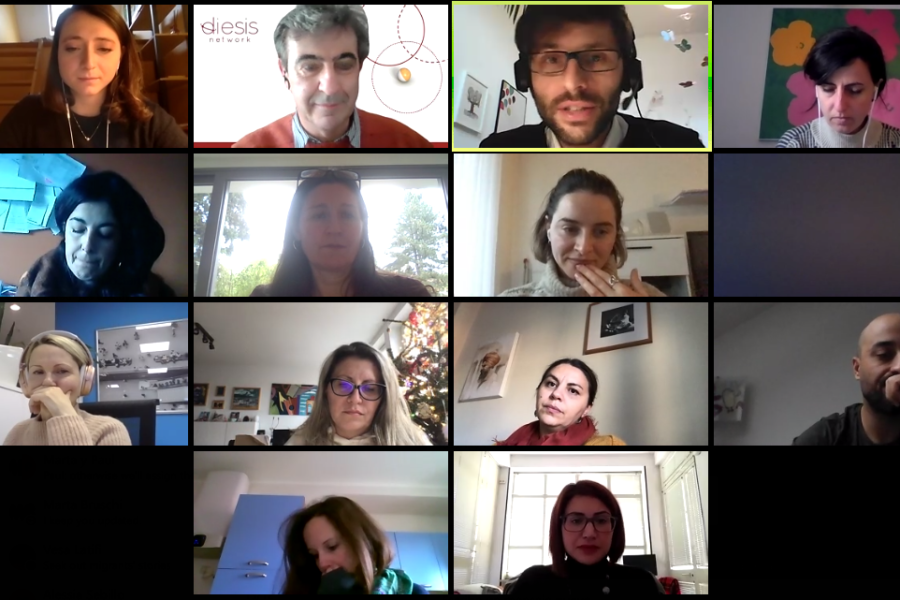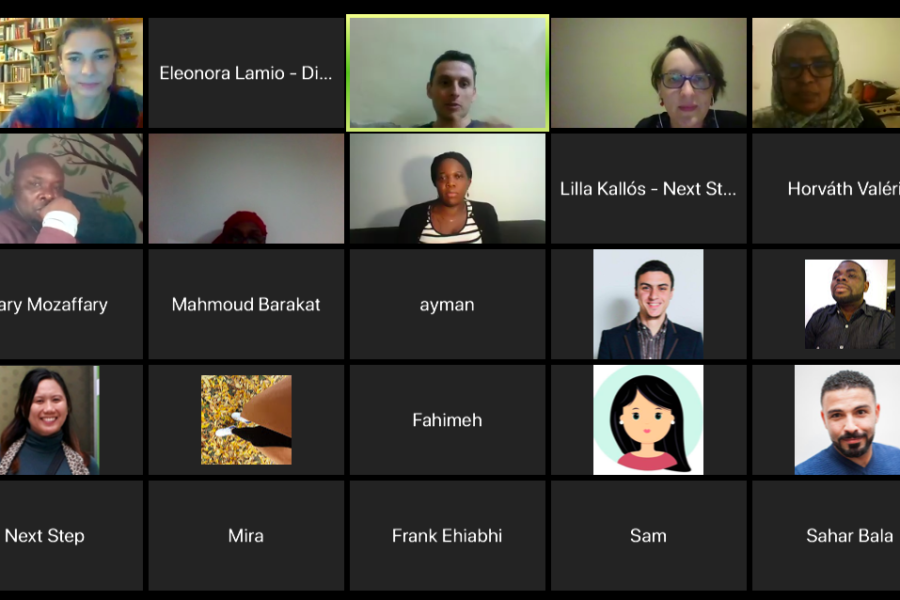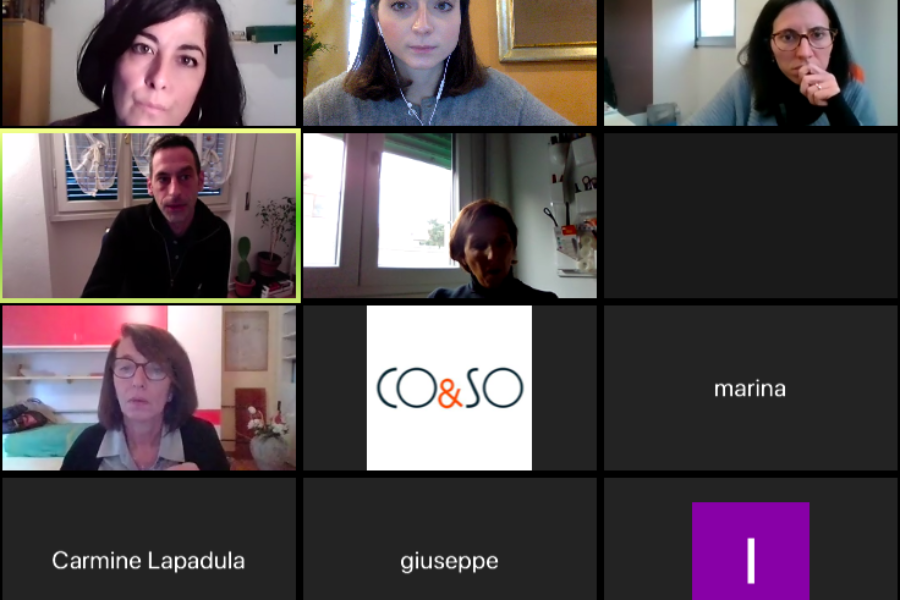

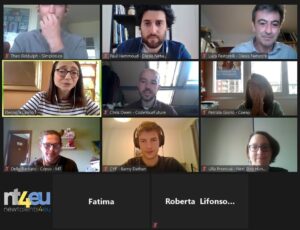
On the 10th of June 2020, from 11 to 12.30, took place the first EU awareness-raising workshop of the NewTalents4EU project. Due to the social distancing restrictions applied for the COVID-19 pandemic, the workshop took place online: over 65 persons registered and more than 40 connected to the webinar.
The workshop started with a short introduction of the project and the results obtained so far, presented by Theo Biddulph, from Simplon, the coordinator of the project. During the first year and a half of the project, training on ITC skills for migrants and refugees have been delivered in four EU countries: France, Italy, the United Kingdom and Hungary.
The online workshop was organized into two main sessions:
- The first one presented two trainings carried out by our partners: CO&SO and CodeYourFuture;
- The second one was composed of two working groups, one on how to build and replicate such ICT trainings and the second one on how these new skills helped migrants to integrate the labour market.
During the first session, CO&SO and Code Your Future presented their experience in implementing their ICT trainings for migrants.
Patrizia Giorio, project manager at CO&SO, explained that they implemented such trainings in two Italian cities: Florence and Lucca. Then, Delio Barbato, a trainer that taught the ICT courses to migrants and refugees in Lucca, shared with us his experience. The courses were focused on the potential of ICT in empowering job finding capacity. In Lucca, they had a total of 14 participants from 12 countries. In Delio’s opinion, there were three critical points: the low linguistic level of some of the students and the language level gap used in teaching; the physiological disparity of the digital entry levels and the specific difficulty to regularly attend the trainings due to sudden displacements in other reception centres. They responded to these challenges by hiring a linguistic facilitator/cultural mediator, the stable presence of a tutor and the continuous communication with the network of entities in charge of the students.
The CodeYourFuture trainings were then presented by Chris Owen, education director of CodeYourFuture: these were carried in Manchester, UK, and in Rome, Italy. He explained to the audience how the trainings were structured: they were an 8-month fellowship with a free part-time program with weekly face-to-face and daily online study groups. The tech skills they provided were full-stack JavaScript, React, Node, Databases, HTML, CSS, Git and Agile. They also gave financial support by supplying resources lowering barriers of entry: laptops, childcare, transportation, internet and meals. CodeYourFuture also offered soft skills training, personal support and mentorship. Chris also provided us with some interesting statistics: 97% of the students had a positive experience at CYF and would recommend it and 70% found employment or moved into full-time studies. Chris’s presentation was followed by Fatima’s, a student who took the training in the UK: she gave us a concrete insight into her experience.
The second session was composed of two working groups.
The first one was focused on “How to set up a training scheme and to replicate it” and moderated by Lila Prontvai, from Next Step Hungary. She presented us the NT4EU project universal training scheme which is a set of training themes that comprise the core of a training program to improve the sustainable labour market inclusion of third-country nationals. The local training schemes are localized versions of the universal training schemes developed by project partners, adapted to the local context in their respective countries, taking into account the salient needs of the third-country national population within those countries. Lila also explained that variations to the NT4EU universal training scheme as developed in the local training scheme allow the overall project objectives to be implemented in the specific local context. It is the aim of the NT4EU project that its developed training practices can be disseminated and adapted into many contexts. The development of local training schemes was an essential outcome of the project. Universal principles and local modifications are meant to demonstrate to and encourage others to undertake similar training programs to improve the sustainable labour-market inclusion of third-country nationals in the broader community.
During this working session, many questions were asked to Lila and to the other partners on the setting up of the training schemes, such as::
- what were the main obstacles that the organizations encountered when giving the workshops and how they overcame them;
- how to finance the courses;
- how to work with volunteers;
- how to support migrants with business ideas;
- if and how they provided financial support to the students; and how to establish these courses.
Finally, Theo Biddulph from Simplon moderated the second working session focused on “The impact of the new skills on migrants’ labour integration”. Theo presented how these new skills supported migrants in their employment situation and asked the other partners of the project to give feedback on their own experience. Plus, he also mentioned the importance and impact of language skills in relation to technical skills for job market integration. He also underlined the role and relationships organizations such as NT4EU partners can have with large companies.
Thanks to the speakers and the partners for their involvement and to everyone who attended the online workshop! We hope you heard and found some valuable information.
See you soon!
Download the Agenda of the event HERE!
Presentations (in PDF – click to open):