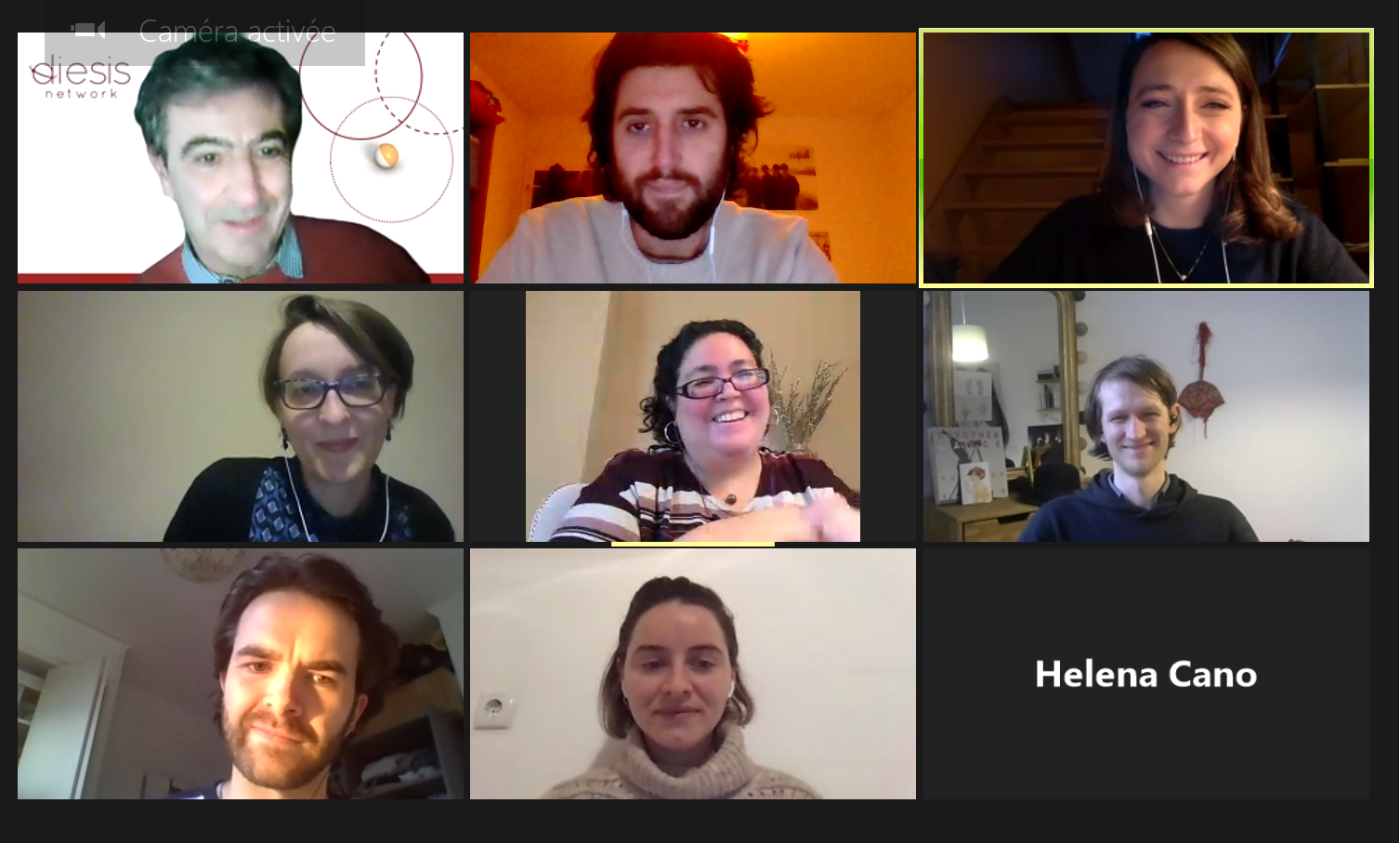
The final conference of the NT4Eu project took place on the 16th of December 2020, from 2.30 to 4.30 and was attended by more than 40 participants! Please find a short summary below with the key points addressed during the conference.
The panel -“Digitalisation: an opportunity for migrants and refugees”
After some welcome words by Gianluca Pastorelli, executive president of Diesis Network, and Eleonora Lamio, project manager and policy officer at Diesis Network, was presented Hortensia Vélez Patón, from DG HOME – Unit E4: Union Actions and Procurement, of the European Commission. She provided an introduction and overview of the project results.
Then, Theo Biddulph, project manager at Simplon and coordinator of NT4EU, talked about the achievements of the project. He pointed out that the aim of the project is giving ICT training to refugees and migrants in order to enhance their integration into the labour market. The trainings have been implemented in France, the UK, Hungary and Italy. The partners have developed both high-level web development courses and basic computer literacy skills courses. The project had a total of 3640 hours of training!
Theo then shared a video: the testimony from a student of the NT4EU project implemented by Simplon. The student said that the training has allowed him to reach new skills and helped him in the research of a job.
After this, the audience had the chance to listen to Vincent Catot, from DG HOME – Unit C2: Legal Pathways and Integration, of the European Commission, on a brief EU policy overview. Mr Catot presented the new Action Plan on Integration and Inclusion, and underlined some key aspects related to the NT4EU project topic, such as:
- the need to support migrants to have better and more effective access to the labour market
- the central role of education and training
- the use of digital tools to boost integration
In other words, explained Mr Catot, this project covers all the aspects of this action plan by providing ICT training for refugees and migrants.
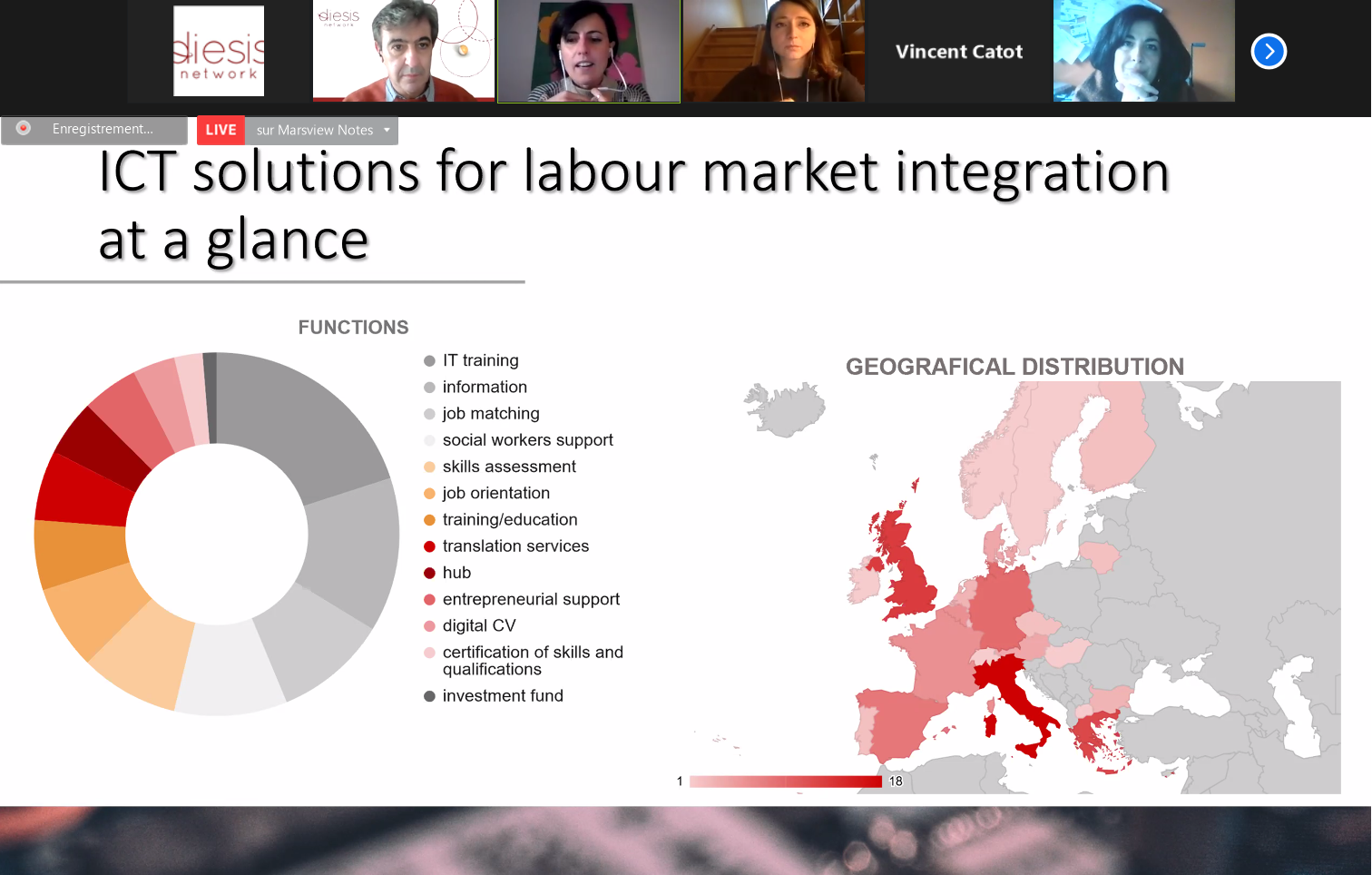
Finally, Leila Giannetto, presented a research carried by FIERI for the LabourInt II project, where the main aim was to explore the potential of technological innovation in refugees’ and migrants’ integration into the labour market by looking at innovative practices based on the use of ICT.
Workshop 1 – “How to cope with COVID-19? The impact of the pandemic on migrants’ labour market integration and the NT4EU experience”
At the beginning of the workshop, Gaia Testore presented the research done within FIERI on the impact of COVID-19 on migrants’ labour market integration. She illustrated the EU’s economic sector challenges in integrating migrants. At the same time, she also underlined that this pandemic has shown the great contribution of migrants to society and their key role in the EU’s economy. Moreover, the pandemic showed that there is a deeper need for job security, notably for refugees and undeclared workers, categories that are very affected by COVID.
Then, Aaishah Khan from CodeYourFuture, presented the CYF experience in UK and Italy. She underlined that the transition to online courses due to COVID was smooth. Nevertheless, there have been some challenges, such as technical issues from the students, volunteer retention and the difficulty in developing a good learning environment for the participants. After her, Halit Oskan, a student from the CYF training, shared his experience. The student described how the mentors helped the participants with their work and how they provided them with advice during this crisis period.
Finally, Lilla Prontvai took the floor and presented the trainings developed by Next Step Association in the framework of the NT4EU project. Next Step had 528 training hours, with more than 50 migrants and refugees’ participants involved. Then, Lilla mentioned that the COVID outbreak had a great impact on the life and priorities of participants. Lilla said that the Next Step Association supported the transition process to an online modality by lending laptops for free to participants, together with counselling on using video communication platforms. She was followed by Svetlana Yakovenko, a Next Step student, who gave a presentation on her experience within the association and the opportunities it gave her.
Workshop 2 – “How to replicate the NT4EU training scheme in other fields”
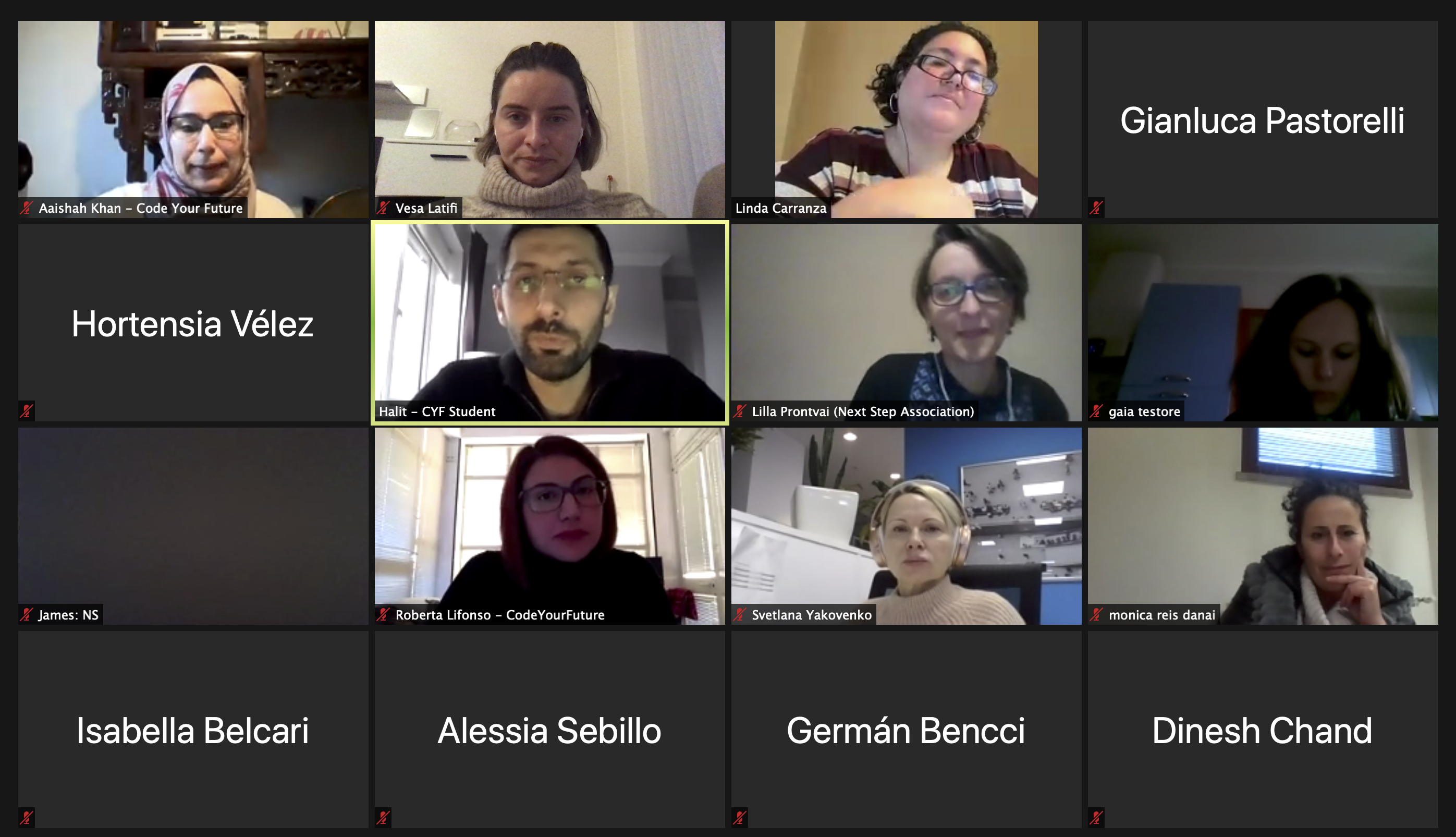
At the beginning of the workshop, Theo Biddulph spoke about the NT4Eu training model and he focused his presentation on some key points:
- The objectives of the model: to design a common IT training scheme to support refugees and migrants’ labour market integration in Europe through IT, languages and soft skills development.
- The basic principles of the model: 1) The main objective of training is professional integration; 2) The trainings are free for all students. 3) Training are composed of IT training and language training.
- The basic criteria of the model: 1) Participants need to have the relevant documents to work in the country of residence; 2) No previous IT experience is required; 3) The most important criteria for integrating the training is motivation and to be ready for a strong commitment to the course
- Common training themes: pedagogy, the application process, language training, working with companies, soft skills, working with volunteer trainers; communication; employability and Evaluation.
Patrizia Giorio then gave the floor to Eleonora Lamio, who presented one of the outcomes of the NT4EU project: the Replication Plan. The Replication plan is a document with information about the main results of the project and some tips and recommendations for replication of the model in other fields of the economy.
Diesis Network identified some main steps in order to replicate the NT4EU training model in other fields of the economy:
- Focus on your target group (refugees and migrants)
- Find replicating actors and supporting ecosystems.
- Identify economy fields with high employability.
- Financial aspect.
- The key role of the social economy.
Eleonora finished with few recommendations for an organization that wishes to replicate these trainings. These are:
- Know your context and the assets of your organization
- Combine hard and soft skills
- Be flexible,
- Be innovative
- Create a community
Finally, Patrizia Giorio gave the floor to Manuela Soro who presented how, following the COVID-19 pandemic, CO&SO has already replicated the NT4EU training model in the field of hygiene. Indeed, because of the COVID-19 pandemic, many companies in Italy seek profiles with preparation in the field of sanitization and in possession of the mandatory certification for the respect of hygiene and food safety.